Stopping a Foundation Crack Before It Became a Structural Failure
A family in Harford County watched a hairline crack in their basement foundation wall slowly widen over two seasons. By the time they called, the crack was wide enough to admit dampness after heavy rain, and they were anxious about whether the wall was still safe to live behind.
Not every crack is a structural emergency, but you cannot tell by looking. Our evaluation started with classifying the crack. Was it dormant, meaning it had stopped moving, or active, meaning it was still working? We measured width at several points, checked for differential displacement across the faces, and looked for the telltale signs of reinforcing steel corrosion. In this case the crack was dormant, the result of initial settlement that had long since stabilized. That made it an ideal candidate for epoxy injection.
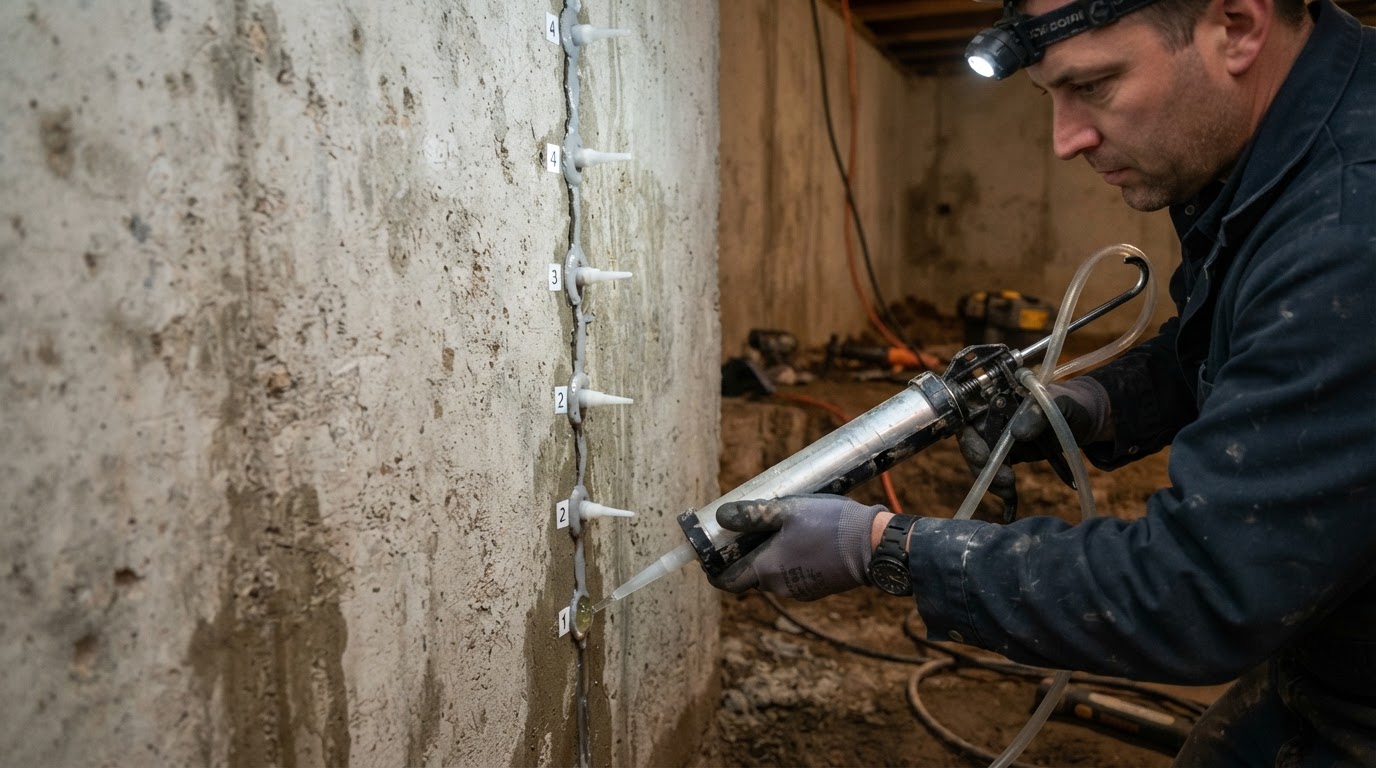
Epoxy crack injection is a method that welds concrete back together. We installed injection ports along the crack, sealed the surface, and pumped a high-strength epoxy into the fracture under pressure until it emerged from the next port. The result is a bond that restores tensile and shear capacity across the break, returning the wall to near-monolithic behavior without the cost and disruption of cutting out and replacing concrete.
Within 48 hours the epoxy had developed full strength. We confirmed the repair with a follow-up visit and gave the owners guidance on monitoring. The dampness stopped immediately. More importantly, the wall's load path was restored, so the crack will not widen into a true structural failure down the road. The whole process is described in more detail on our concrete repair page.
There is a common misconception that a foundation crack means you need a new wall. It rarely does. The right question is whether the crack is moving and whether it has compromised the wall's capacity. A professional diagnosis answers both, and only then can the correct repair be chosen. For active cracks, a flexible sealant or engineered movement joint may be the better choice. For dormant structural cracks, injection is often the cleanest fix.
We also took time to check the exterior. Poor drainage and saturated soil are the most common root causes of foundation cracking, and no repair holds if the water pressure keeps building. We pointed the owners toward simple grading and downspout improvements that will protect the wall for the long term. If you have a crack you are watching, contact us for an evaluation before another season passes.
A crack is information. Read it correctly and you fix the wall. Ignore it and you fix the consequences. We are here to help you read it correctly.