Stabilizing a Historic Fieldstone Foundation in a Crawlspace
A homeowner with an older property noticed uneven floors and a musty crawlspace. In the crawlspace, the fieldstone foundation walls were showing gaps where mortar had fallen out, and a few stones had shifted. They worried the house was slowly sinking. The fieldstone foundation was indeed in trouble, but the solution was careful repointing with the right mortar, not the major reconstruction they feared.
Fieldstone foundations are common in pre-twentieth-century buildings across Harford County. They were built with locally gathered stones laid in a lime mortar. That mortar is soft, breathable, and sacrificial by design. Over decades, especially in a damp crawlspace, it erodes. As mortar is lost, stones shift, the wall loses its interlock, and the structure above can settle. The fix is to repoint with a compatible lime mortar that restores the bond without changing the wall's character or breathability.
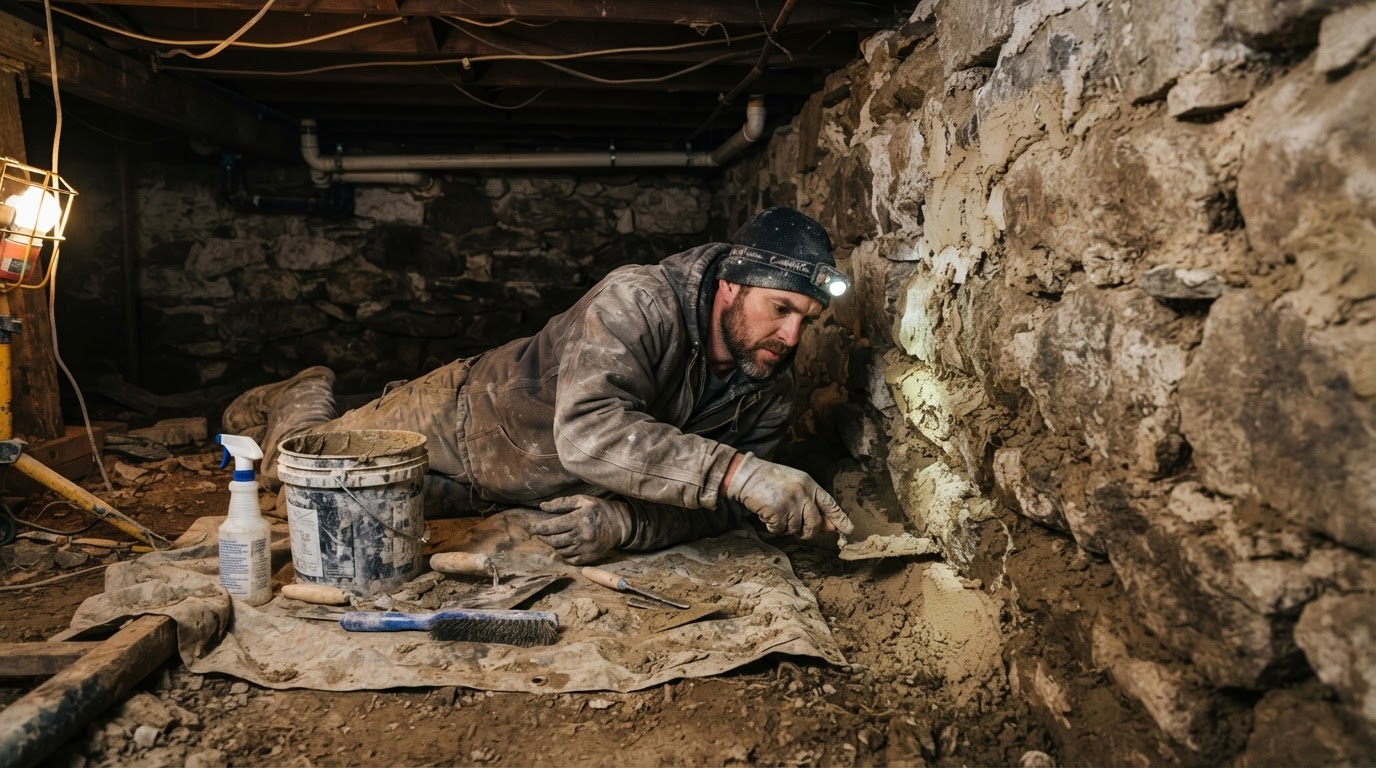
Working in a crawlspace is demanding. Access is tight, lighting is poor, and the work has to be done lying down. We removed the loose and failed mortar from the joints to sound depth, cleaned the voids, and repointed with a lime mortar matched to the original. Lime mortar is the correct choice here because it flexes with the stones, allows the wall to breathe, and does not trap moisture the way hard cement mortar would. The methods are central to our historic preservation and masonry repair work.
We reset the shifted stones, restoring the wall's interlock. As the new mortar cured, the foundation regained its continuity, and the settling that had caused the uneven floors stopped. We also addressed the crawlspace moisture that had accelerated the mortar loss, because no repointing lasts in a chronically damp environment. Improved ventilation and a vapor barrier reduced the humidity dramatically. For moisture management at foundation scale, see our waterproofing services.
The homeowner now has a stable foundation and a drier crawlspace, and the historic character of the fieldstone is preserved. The project is a good example of why diagnosis matters. A settling fieldstone foundation can look like a catastrophic problem, but the root cause is often just lost mortar, and the right repair is sympathetic repointing rather than replacement.
If you have an older home with a stone foundation, have the crawlspace inspected. Mortar loss is gradual, and catching it before stones shift saves both money and structural distress. Contact us for an evaluation that respects the age and materials of your foundation.
A fieldstone foundation is not a weak foundation. It is a flexible one that needs its mortar renewed periodically, the way a good wall always does.